Posts

Showing posts with the label Period Film

Mughal e-Azam [1960] : K. Asif

Image
  K. Asif’s Mughal e-Azam [1960] is one of the wonders in world cinema, as Tajmal is in the world architectural beauty. South Asian cinema cannot get rid of its influence especially Sanjay Leela Bhansali’s period films are greatly influenced by its parts of narrative style especially queen Jodha’s waiting to meet with her son prince Salim after many years later. The same dramatic style and facial expressions I noticed in Bhansali’s Devdas when Devdas meets with his mother.   By its art direction especially set design have overly influenced Bhansali’s films especially the shish mahal set of “Payer Kiya to Darna Kiya” with “Deewani Mastani” in Bhansali’s Bajirao Mastani [2015] are common in their styles, moods and textures. Even the tradition of Indian melodramatic subplots of two counter female characters confronting with each other in a dance and music sequences are an establishment in Bhansali’s movie such as Anarkali & Bahar’s musical confrontation of “Teri Mehfil Me...
Yojimbo : Akira Kurosawa

Image
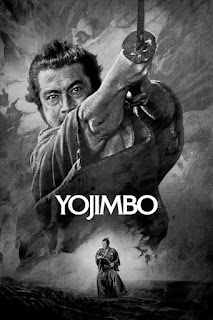
"G o home to your mother and live a long-life eating gruel” -Sanjuro [Toshiro]   One of the best philosophical directions of human life; either live a long life peacefully or live a lavish short life, I have found in the Yojimbo [1961]. What man is quest for ultimately; especially in the realm of arts & cultures is always a big and unsolved question to me. There may not be an exact answer we can get, not in the past, present and not even in future. Since I have been watching Kurosawan films some contemplation appears in my mind that: literally I have observed that humans are not capable of seeing the complete sequences of lives of a person, a family or group at once. Reading can give a glimpse of them; but films make better because of its advantage of auditory, visual and common engagement with the form.   Yojimbo [1961] is one of the thrilling and aesthetically pure in the genre of political allegory I have seen as of today. I have found a sheer semblance wi...

Throne of Blood : Akira Kurosawa

Image
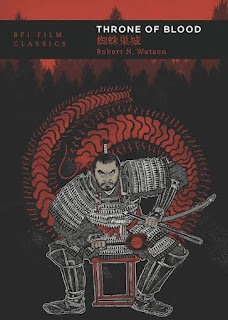
  Sometimes, I watch some parts of a film in mute mode like the silent era; I do not read the titles. The reason behind these errands is very crucial to me; firstly, I want to catch the story line without external assistance then comes the point of finding the thrilling cinematic tempo and pace of the film themselves. If I can stand by the following sequences and enjoy the moments of watching the film, I come to the conclusion that this is a good film and can survive the taste of time and space beyond borders. This is one kind game for me as of today.   I was not informed about the inspiration of Throne of Blood [1957] and it is likely a Japanese adaptation of Shakespeare’s Macbeth [1606]. But in the course of the watching, the film seemed to me a bit gray and monotonous in the tempo and mood. May be mostly because of its theatrical, gothic and formalist staging and acting. But Akira’s cinematic compositions, Toshiro Mifune’s spirited acting and Masaru Sato’s subtle musical sc...

Seven Samurai : Akira Kurosawa

Image
                                                                    " This is the nature of war: By protecting others, you save yourselves.                                     If you only think of yourself, you'll only destroy yourself "   When I heard Kambei Shimada ’ s dialogue , a  ronin , the leader of samurais  starred by  Takashi Shimura ; I just press the pause button instantly to hear it repeatedly and felt a great pleasure and thought that is the essence of human artistic prestige that drive us to surrender to art both spiritually and philosophically.   If Rashomon [1950] was about technically triangular compositions then Seven Samurai [1954] is about cinematically crowd compositions. I am amazed w...